


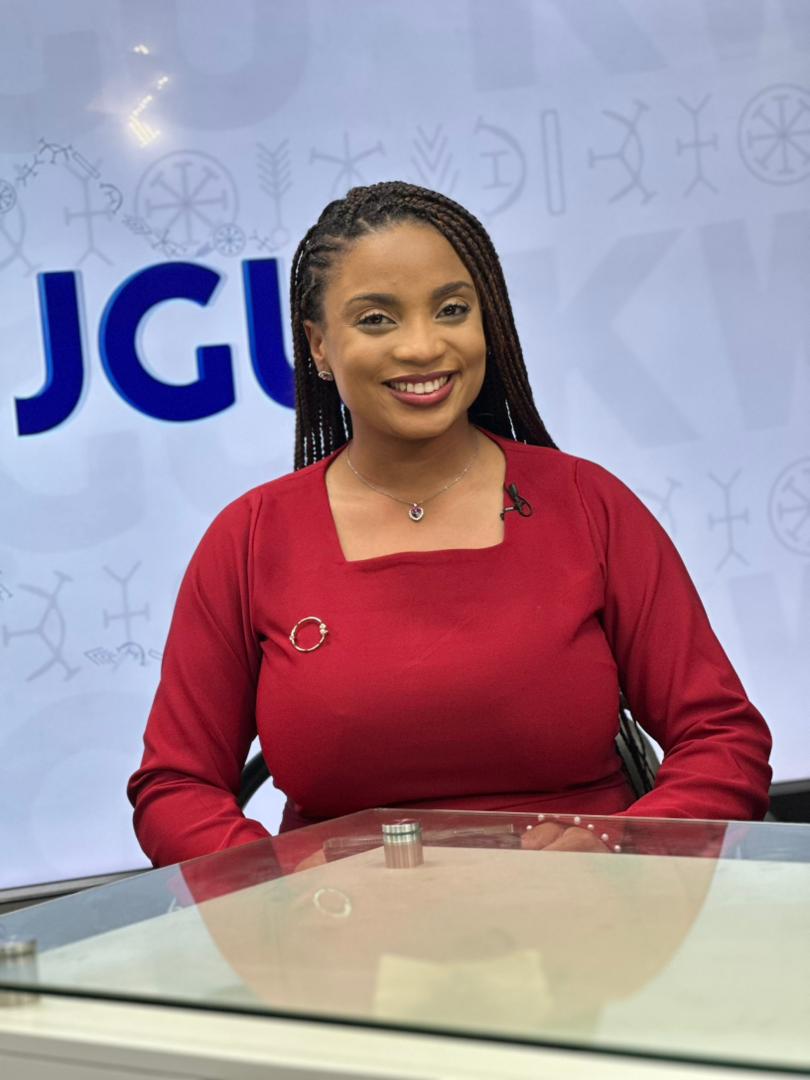
If you’ve turned on TV anywhere in the Southeast in the last year, chances are you’ve seen her: that presenter with the confident voice, fast mind, and smile that looks like it knows something before the guest does. That’s Nathalie Ukwu, the fast-rising star whose work has Afia TV reflecting the vibrancy and voice of the Southeast like never before.
A flyer from her father was all it took to open the door. Three years on, she has turned that opportunity into a platform, anchoring The Afia Morning Show, Enugu Kwenu, Eastern Promises, and Afia Spotlight. Audiences don’t just watch the stories; they stay for her: her sharp mind, quick wit, and magnetic presence that make viewers stop, watch, and remember her name.
She’s 28. She’s fearless. And in just three years, she has gone from the fresh University of Nigeria, (UNN) Nsuka graduate to one of the most influential young journalists on air, leading Afia TV’s rise with a quiet authority that feels anything but accidental. And if the first three years are any indication, the next decade of Nigerian broadcasting won’t just watch her; it will adjust to make room for her.
In an exclusive interview with The Naija Broadcastar’s publisher Babs Daramola, Nathalie Ukwu speaks about her meteoric rise, the price of being taken seriously at 28, and why the Southeast no longer waits for national validation.
When did you first realise you wanted to sit in front of a camera or microphone and own the morning for thousands of viewers in the Southeast?
Ever since I was a child, I wanted a corporate career. Though I had hobbies, in my child-like mind, I always pictured myself in corporate attire attending high-profile meetings. So, it never really was specifically broadcasting. As the years went by, I probably found more of myself in literature. But something changed in final year university, I started to admire journalists I watched on TV and the confidence they had.
A year after graduation, my interest further deepened in 2020 during the COVID-19 pandemic when all we could watch was the news, mostly to know whether it was all finally over! The carriage, the tact and skill of these reporters and anchors were what I noticed first. It was then I knew I wanted to make the difference…the impact these essential workers were making. And just when I considered other opportunities in about 2022, my father sent me an Afia TV flyer, and here we are.
Growing up, which Nigerian broadcaster (male or female) made you say, “That’s exactly how I want to do this one day”?
Beyond broadcasting, my mother’s dedication to her work as a medical professional was the key motivation I had. But in the field of broadcasting, Christiane Amanpour, I admired as a foreign journalist, and Ojy Okpe for Nigerian, I adored her, and still do.
Afia TV is proudly regional, yet your analysis often goes national. How do you strike the balance between speaking to the Southeast and speaking for the Southeast?
News is about people doing things, people not doing things, going places and doing great things in those places. South-Easterners are travelers and easily find themselves in other parts of the world. So, our searchlight follows them. As for issues concerning people not from the region, the impact of their activities are felt nationwide. So we have to make people in the South-East region understand the impact on their region. For us, it’s all about the impact. If it’s not this, then it’s just another story.
The AM Show and Enugu Kwenu are live, high-pressure environments. Walk us through your personal routine 30 minutes before you go on air. What keeps you calm and sharp?
As the active producer of both programmes, at the final 30 minutes, I must be aware of my guest (s) and my script has to be ready, I ensure I am up-to-date with the latest facts, I fact-check, review my script and send it to the Control Room. I follow-up with them, explaining the content to them, then I rush in to do my make-up and then arrive in the studio for the final technical side, before we go live.
To stay calm, I never forget to breathe … yes, it’s possible for a broadcaster to initiate personal panic by forgetting to breathe consistently at this time: signs of this being increased heart rate, speaking very quickly and being generally tense! So, I breathe steadily.
“Nathalie during an exclusive interview with Governor Peter Mbah”
Secondly, I converse with the crew, energising them by engaging in light conversation as we prepare, and the guest as well. It reminds us that there is nothing to be worried about. In the beginning, my supervisory producer and mentor at the office, Nnamdi Obanya would be in the Control Room, reminding me to smile when I became too serious. Now I hardly forget to smile.
Which single interview in your career so far stands out, and why?
The interview that stands out for me was with the Governor of Enugu State, Dr. Peter Mbah.as part of a documentary we produced at Afia TV on his 180-day water promise. It was an exclusive in his office at the Enugu state government house, and indeed the first time I would engage in such a high-profile interview. I recognised that it was an important interview and had to prepare well ahead of time. It was hard to remember to breathe as the moment eventually came, but as soon as Ifeanyi Alapo, our production manager at the time said “Action!”, the interview had to go on. In the end, the interview was a success. It made me understand that with the right team, and steady breathing ofcourse, we can achieve a great interviews.
I am still incredibly humbled by the opportunity to have conducted this interview at such an early stage in my career.
Before your broadcast career took off, you were already making waves academically, graduating as the best student of Mass Communication at UNN in 2019. What did that achievement mean to you at the time, and how has it shaped the way you work today?
At the time, I never thought I would make the list. I studied to do well, but not because I felt I could make the list…maybe I did not find myself worthy. My classmates were very bright and extremely hardworking.
Adding to my surprise was that, in present-day Nigerian universities, checking results is now largely personal, so you do not get to compare grades as if the results were pasted on a noticeboard for all to see. So, when I got the information, I was beyond surprised and deeply humbled at the same time.
For context, in primary school, I was sometimes referred to as a “late bloomer” because I was not the brightest in my class. In secondary school where I studied, Vivian Fowler Memorial College, Lagos, I was in the science class, but my interest was in literature and the Arts. I actually won an award on graduation day as best student in literature. For a science student, it was quite shocking. So, in the university, I turned my attention to the Arts and saw my interest improve.
So this is what it meant: it meant that, maybe I truly was a “late bloomer”. Maybe I was not bright enough in my early academic years. But, in my later years, I had to work a lot harder to succeed in the sciences, which eventually paid off. But, for the Arts and literature, I just loved it, and my parents recognized this too.
Today, the result has shaped my work by making me feel a little more confident. Now, trusting God and putting in the effort drive me more than anything.
You’re only three years on the job, but you’re already making your mark. A lot of young ladies in Enugu, Anambra, Abia, and beyond would now be saying, “I want to be like Nathalie.” What advice do you have for a final-year Mass Comm student who wants to break into TV tomorrow?
“Think beyond the first show, once you can see beyond this, you will achieve success.”
You script, present, and sometimes shape the editorial direction. Which of these three hats excites you the most right now, and which one do you want to grow into in the next five years?
Presentation. Definitely presentation. Once the script is ready, I shift away from writing to getting in the right mood for the interview. The result…how you present matters. For growth, I still want to improve in my presentation, by one day having all the information I need at my fingertips through non-stop research.
If a big national or international network came calling tomorrow with a prime-time slot, what would make you say “yes” and what would make you stay with Afia TV?
This is a very tough question because joining Afia TV launched my career in ways I could never have imagined. But now that you have asked, my answer is simple. The single thing that would make me accept this is if I feel that I have contributed as much as I have gained in terms of growth from my Afia TV family. So, you may ask, how would you know when this point has been reached? I suspect it would come as a feeling that I would not be able to miss. Also, the nature of the opportunity and how it aligns with my trajectory in journalism would be crucial.
Ten years from now, when people mention your name in Nigerian broadcasting, what one thing do you want them to remember you for?
The questions I asked, and the emotions they provoked. Because the answer is not in the words, but in the gestures, the mood in the room when the question is asked: the non-audible cues.
You’re young and undeniably beautiful on screen. Does that ever bring extra pressure? How do you cope with the challenge of people focusing on your looks instead of your journalism?
Firstly, thank you for the compliment. But here’s the thing: I guess they forget the looks once the interview begins. I make sure I leave them with no choice than to focus on the session!
Finally, who is Nathalie when the red light goes off and the makeup comes off?
A lover of family, obsessed with the moments we create when we are together, and ultimately, a woman and a half.
Whether she’s scripting a hard-hitting interview or laughing with her crew seconds before going live, one thing is certain: Nathalie Ukwu isn’t just on television; she’s building a legacy. And if the first three years are any indication, the next decade of Nigerian broadcasting won’t just watch her; it will adjust to make room for her. TNB