


By Babs Daramola
Editor-in-Chief
Every industry has a king. Some earn the crown, some inherit it, some fight for it every day. Nigerian broadcast journalism is no different. And for over two decades, one television station has dominated conversations, set standards, won global awards, and built a culture of credible news: Channels Television.
To many Nigerians at home and abroad, Channels TV isn’t just a station; it is a brand synonymous with trust, stability, and consistency. Its founder, John Momoh, arguably one of Nigeria’s finest broadcasters ever, didn’t just build a television company; he built an institution that shaped modern broadcast journalism in the country.
From day one, Channels positioned itself as a serious news platform. No noise, no gimmicks, just clarity, substance, and disciplined storytelling. It wasn’t the flashiest, but it earned what many others still struggle to command: respect.
But today, the media landscape is not what it was ten or even five years ago. The rise of digital-first consumption, audience fragmentation, online competition, aggressive new players like TVC News and Arise News, and declining traditional TV viewership have forced a question once considered unthinkable: Is Channels Television still Nigeria’s number one TV station, or has the media crown quietly moved on?
Let’s be honest: for more than a decade, Channels had no real rival. It dominated election coverage, political discourse, national talk shows, and public trust ratings. The fantastic team of pioneer journalists: John Momoh himself (who read the very first news) and his wife Sola, anchoring the news; Kingsley Uranta (pioneer News Editor, now back as GM Academy), Ambrose Okoh, Arthur Chukwuma, Akeredolu Ale, Betty Dibia, Lekan Ashimi, Tonia Imu-Ejeye—became fixtures in Nigerian homes.
The momentum was carried by a wave of talented broadcasters like Deji Badmus (now CEO of TV 360), Gimbar Umar, Siju Alabi, and later, the likes of Chamberlain Usoh, Amarachi Ubani, Maupe Ogun-Yusuf, Seun Okinbaloye, Gloria Ume-Ezeoke, and Kayode Okikiolu. Channels was once so far ahead that the real competition wasn’t between TV stations; it was Channels versus Channels.
Then the game changed.
Viewers developed new appetites: sharper conversations, more fire in interviews, global-standard production quality, and stronger on-screen studio aesthetics. Stations like TVC, with the financial muscle of its billionaire owner, stepped in with cleaner sets, premium lighting and sound, and youthful energy. Then Arise News entered the arena like a storm: bold, elite, international, and disruptive. With presenters who push power to the edge: international broadcaster Charles Aniagolu, Dr. Reuben Abati, Sumner Sambo, Ndee Amaugo, Rufai Oseni, Ngozi Alaegbu, Ayo Mairo-Ese, Ojy Okpe, and others, Arise didn’t just join the conversation; it rewrote the tone of Nigerian television news. TV news suddenly became engaging again, and for many viewers, addictive. Arise TV carved its own niche.
And just when it seemed the battle for dominance was a two-horse sprint, News Central quietly entered the field: focused, calculated, and fast-rising. Led by industry virtuoso Kayode Akintemi, the channel blends the sharp instincts of seasoned broadcasters with the energy and innovation of a young newsroom, backed by strong digital integration. Powered by veterans like Louis Eke, Chuks Ene, Tolulope Adeleru, Joe Hanson, Felicity Ezewuike, Gbenga Aborowa, and a nouvelle wave of broadcasters like Blessing Mosugu, Olive Emodi, Lekan Onabanjo, Judith Atibi, News Central is attracting an audience that wants global-quality storytelling with African depth. It doesn’t chase noise; it builds identity. In just a few years, it has emerged as the dark horse of Nigerian broadcasting: consistent, serious, and steadily expanding its influence.
So, where is Channels today in this new battlefield? It remains respected, but not exciting. Trusted, but not trending. Strong, but no longer unchallenged.
Its biggest strength remains what built the brand in the first place: journalistic discipline. Channels still delivers structured news, measured analyses, and professional presentation. It maintains editorial balance in a country where media bias is often obvious. It is still the most institutional news station in Nigeria: calm, composed, and credible.
However, viewers now demand more than credibility. They want dynamic storytelling. They want bold interviews. They want studios that look world-class. They want conversations that reflect the energy of this generation. Channels appears to be struggling to evolve fast enough. The station still carries the feel of old-school television: safe, predictable, and sometimes too formal for a digital audience that now consumes news side by side with reels, podcasts, and TikTok clips.
Even loyal viewers now ask: Where is the reinvention? Channels cannot afford to watch competitors redefine TV narratives while it maintains a legacy model. Legacy is good, but reinvention is survival.
To remain at the top, Channels doesn’t need to copy Arise or TVC. It needs to evolve into a stronger version of itself. Sharper studios. Bolder editorial segments. More personality-driven news. Smarter digital presence. Deeper youth engagement. And voices that connect not just with the head, but with the heart of the audience.
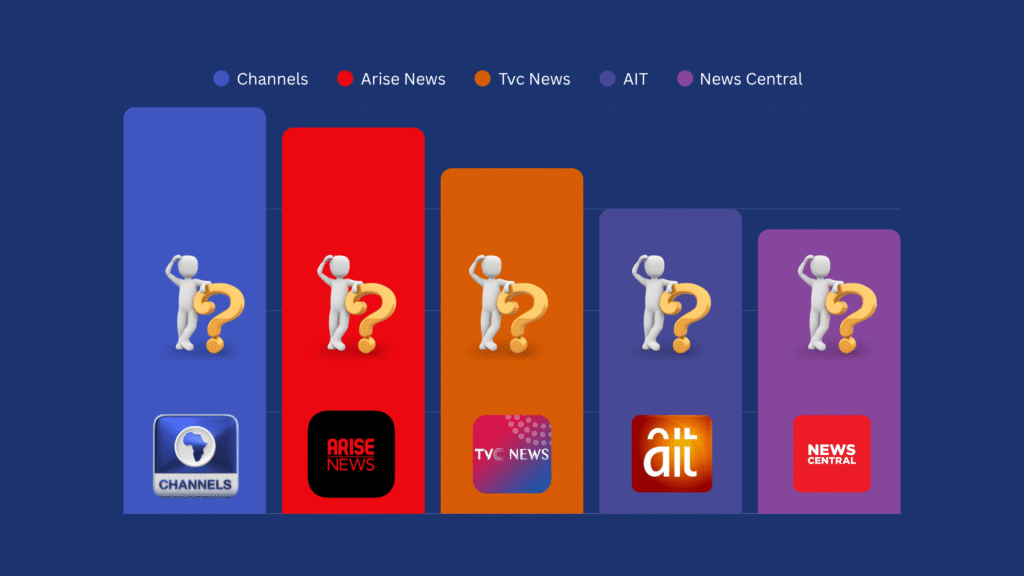
Here’s the truth: Channels is arguably still number one. But what does that mean in today’s shifting media landscape? Is credibility alone enough to secure dominance, or has the audience’s appetite for innovation changed the rules entirely?
Viewers demand more than trust and discipline. They want dynamic storytelling. Bold interviews. Studios that feel global. Conversations that match the energy of a generation consuming news alongside reels, podcasts, and TikTok clips. Can Channels evolve fast enough to meet these expectations, or will its legacy become a gilded cage, beautiful but limiting?
The debate isn’t about whether Channels was number one ; it clearly was, and still is. The real question is: will it still be number one in the next three, five years, or fade into legend? And as competitors like Arise, TVC, and News Central push boundaries with creativity, digital integration, and on-screen personality, can Channels maintain its Frontline status without reinventing itself?
For Channels TV, the crown is still on; but is the throne beginning to shake? Will it adapt in time, or will rivals redefine the narrative while it clings to tradition?
TNB